Is Your Digital PR Already Influencing AI Search?

Stephen Baker
14 May 2026
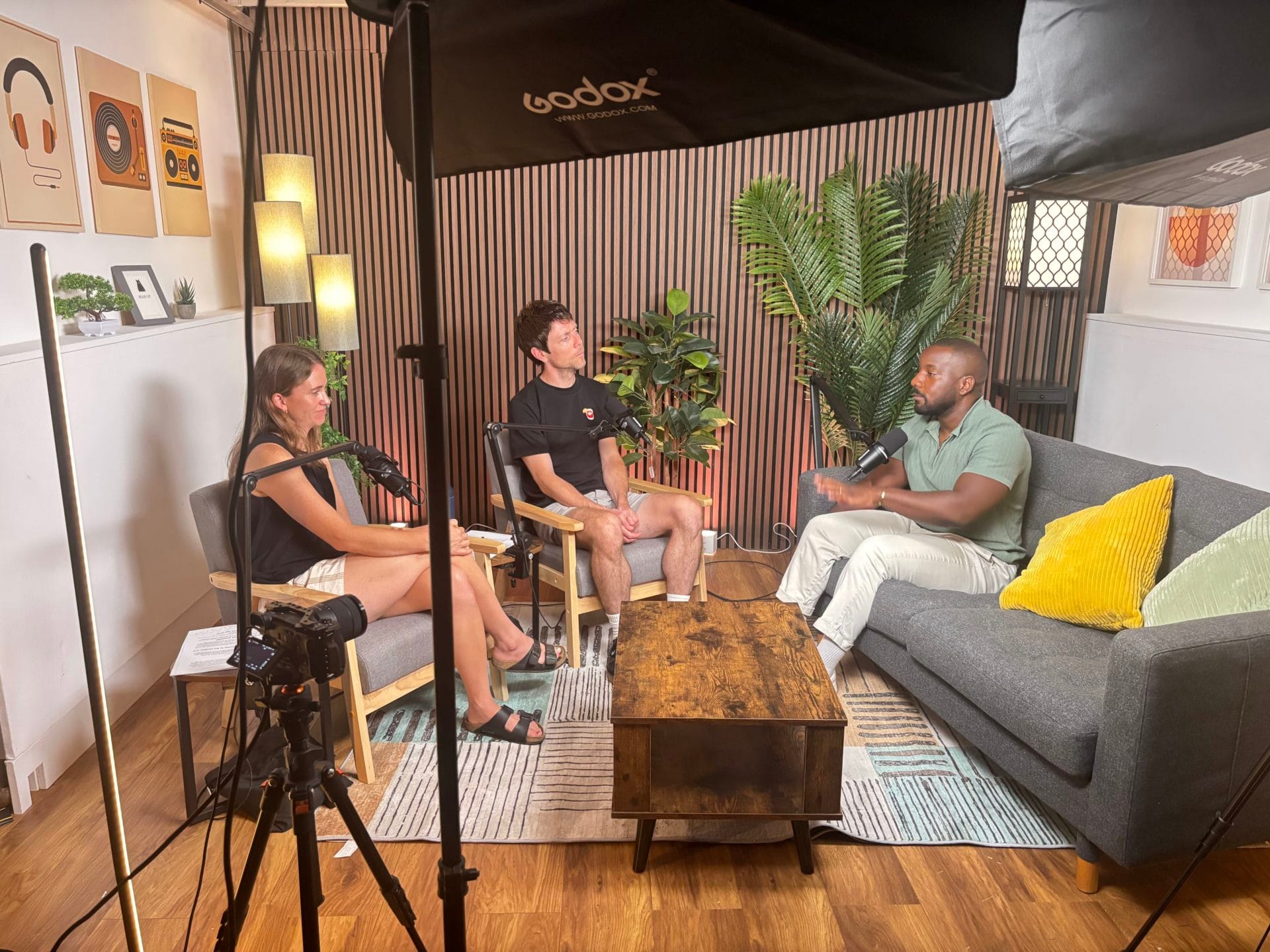
Sophie Coley and I had the chance to speak at Digital Superchats about something that’s been shaping how we think about digital PR: the role it plays in both traditional and AI search in 2026 and beyond. If you want to watch the full talk, you can here.
The session was built around a simple but important premise. AI search is fundamentally reshaping how audiences discover information, and digital PR has evolved from a link-building tactic into a critical influence layer across both traditional and generative search. We covered how PR strategy now needs to operate across three timelines at once: immediate SEO impact, mid-term brand visibility, and longer-term influence on AI training data. We also touched on what the approaching agentic era might mean for how we work.
A couple of years ago, we ran a campaign for CV Villas looking at the science behind the World’s Bluest Waters. It performed brilliantly in traditional search, where we secured a number one position in Google for “villas in Greece”, ahead of Airbnb. Job done, right?
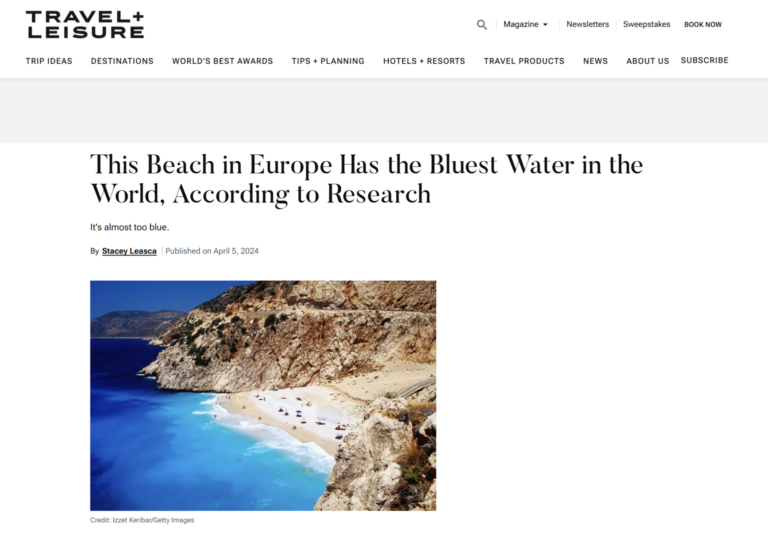
What we didn’t fully appreciate at the time was what else it had achieved. When we looked back at the campaign through an AI search lens, we could see it had also driven visibility in AI Overviews, and that the coverage we had secured was actively contributing to how LLMs understood the brand. ChatGPT was describing CV Villas as one of the best luxury villa rental companies in the UK, not because we had engineered it that way, but because the campaign had done that work incidentally.
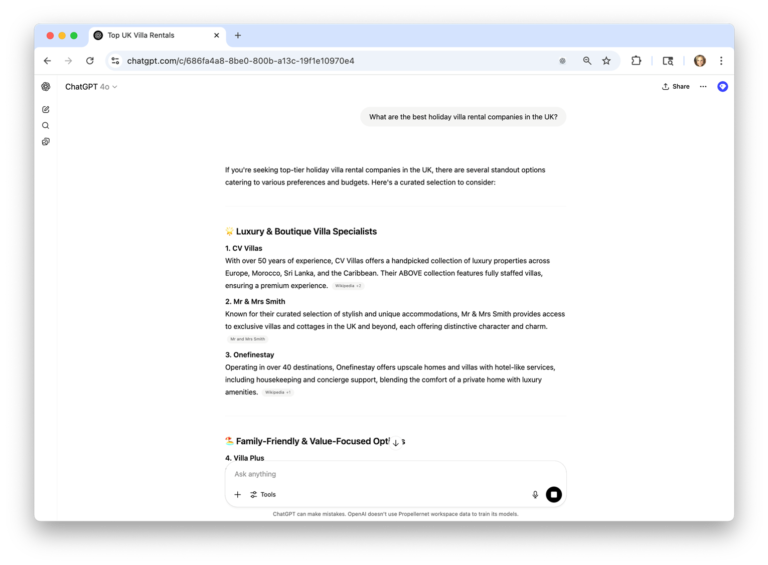
If you are running digital PR campaigns and securing online coverage, links and brand mentions, you are already influencing AI search. The question is whether you are doing it deliberately.
Two routes in, and PRs can influence both
Before getting into tactics, it helps to understand how LLMs actually generate their answers, because there are two distinct routes, and they need slightly different approaches.
The first is knowledge bank retrieval. This is everything an LLM has absorbed through training, its foundational understanding of brands, topics and the world. The second is web search retrieval. When a prompt signals a need for fresh or specific information, the LLM turns to the web in real time, very much like a search engine query.
Both routes matter. And both are open to PR influence.

Influencing the knowledge bank: think long-term, think licensing
The knowledge bank is a slower burn. LLMs update their training data intermittently, and some of those cutoff dates lag significantly behind where we are now. Google’s latest model, for example, had a knowledge cutoff of January 2025 as of this year. That is a meaningful gap, and it means the impact of any coverage you secure today may not be felt until the next model update.

What has changed the calculus significantly is licensing. Different AI companies have formal licensing agreements with media publishers, and that content feeds directly into training data. ChatGPT has disclosed agreements with News Corp, Associated Press and a range of others, which means coverage in titles like The Times, The Sun, TechRadar, Digital Spy and Condé Nast publications has a materially higher chance of feeding straight into the knowledge bank. This is the new gold standard for digital PR aiming to influence LLMs, in the same way that Domain Authority was once the proxy for traditional search value.
Targeting these publications will not always be possible for every brief, but it should be part of your strategic thinking, especially for clients where AI search visibility is a priority.
What you say in that coverage matters as much as where it lands
Once you are thinking about knowledge bank influence, the framing of coverage becomes critical. LLMs learn associations. They pick up on how brand names are paired with topics, categories and expertise, and they repeat those associations when answering relevant prompts.
This is something our Head of PR, Louise Parker, covered at Digital Superchats last year, but it is worth revisiting. The “According to [Expert] from [Brand]” structure in expert comment and press quotes is good journalism practice and a training signal. Consistently pairing your brand name with your key product or category, whether that is “energy provider”, “luxury villa specialist” or “insurance comparison website”, across every piece of outgoing comms is how you help an LLM learn the right associations over time.
It also means thinking about PR campaigns in terms of the topics you want an LLM to associate with your brand, not just the keywords you want to rank for. For CV Villas, every campaign we run is designed to reinforce the brand as a luxury villa specialist connected with beautiful beaches, glorious experiences and the bluest waters. The best boat day destinations. The most magnificent swimming spots. Those are not just editorial hooks, they are the associations we are actively building in AI’s understanding of who they are.
Influencing web search retrieval: two tactics worth a closer look
The web search retrieval side of things is more familiar territory for anyone with an SEO background, with a few important twists.
The first is product and affiliate roundups. Best-of lists on sites like TechRadar, The Independent and Digital Spy are currently among the most commonly cited sources when LLMs answer product recommendation prompts. Getting your client featured in those roundups is still the goal, but the lever has shifted. If your client has an affiliate scheme, make it part of your pitch. Flagging that scheme to journalists, and potentially offering a preferential commission rate, materially increases the chance of inclusion. It is something PRs may have shied away from in the past, but in the current landscape it is one of the most direct routes to short-term AI web search visibility available to us.
The second is fan-out query optimisation, which sounds more technical than it is. When an LLM turns to the web to answer a prompt, it does not just search the original phrase. It breaks the prompt down into multiple sub-queries and fires them at search engines. For “good gyms in Leeds”, an LLM might run searches including “good gyms Leeds”, “best fitness centres Leeds” and “gyms Leeds reviews”, some of which feel very human, some of which really do not.
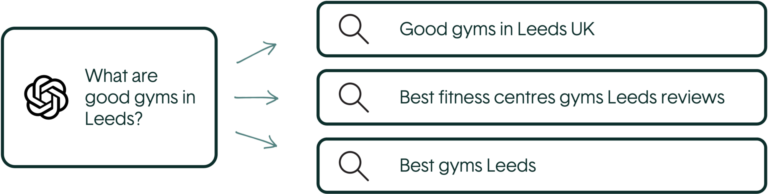
If you can identify what those sub-queries are for your client’s key prompts (and there are tools that help extract them), you can use PR-driven link building to boost rankings for the pages most relevant to those queries. That is exactly what we did with PureGym in Leeds, securing a link from a local PT to the relevant PureGym Leeds page. Tactical, measurable, and very compatible with an existing digital PR skill set.
The campaigns that do both
The most efficient approach, and the one that most clients will need, is activity that influences both the knowledge bank and web search retrieval simultaneously.
Our annual UK Fitness Report for PureGym is a good example. Data-led reports have long been a digital PR cornerstone: they live on the client site, earn links, become evergreen resources and support ranking for target keywords. All of that still holds. But now they are also doing two additional jobs. They are building topical authority with LLMs over time through training data, establishing PureGym as a genuine authority in fitness, and they are making the brand directly discoverable when an LLM performs a web search to answer a relevant prompt.
One asset. Traditional search value. AI knowledge bank influence. Web retrieval visibility. That is a strong return.
Reputation matters more than you might think
There is a final piece that I think often gets underestimated. Showing up in AI answers is one part of this. What those answers say about you is another.
Audiences now have an increasingly convenient way to research brands before they buy, and LLMs are very good at quickly synthesising everything good and bad from across the web. Reddit threads, review platforms, forums, social media: an LLM actively weights community and third-party content when forming a view on a brand. Digital PR’s job is to positively influence all of those touch points.
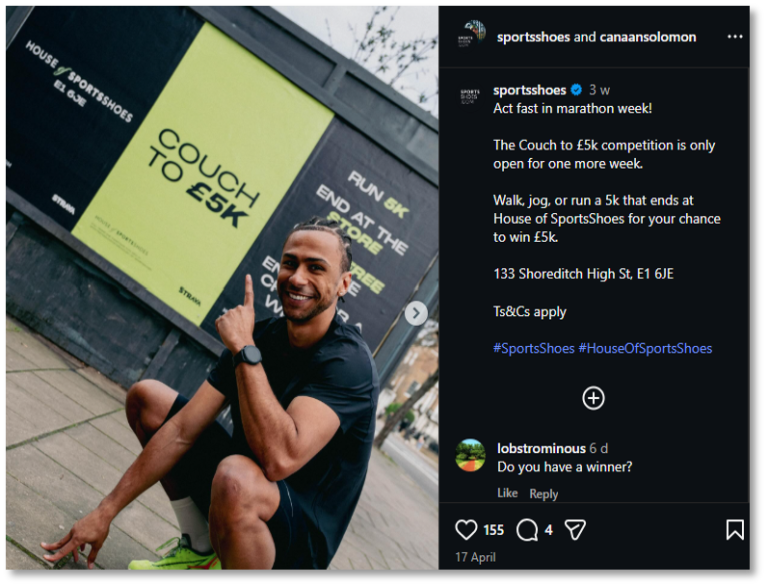
That means thinking beyond the coverage itself. For a recent SportShoes campaign promoting their new store and Couch to 5K competition, we secured great coverage and extended it into owned social activity too. That multi-touch approach reaches more customers and shapes the signals that AI picks up on. The brands that understand their visibility as a whole ecosystem, rather than a list of links, will be better placed as AI search matures.
What comes next
Sophie touched on the agentic era, explaining that AI agents retrieve information, make decisions and take actions on behalf of users. This shifts the question from “how do we appear in search?” to “how do we get selected by an agent?” Reputation and personalisation will be central to that. PRs, who arguably understand brand perception and audience behaviour better than most teams in a business, are well placed to lead on both.
For now, the priority is doing deliberately what many of us are already doing incidentally.
- Understand whether your key prompts pull from an LLM’s knowledge bank or its web search.
- Target the publications with licensing agreements.
- Be consistent about how brand names are paired with category and expertise.
- Build topical authority through campaigns and data assets.
- Keep a close eye on what AI actually says about your clients when you ask.
If any of this resonates or you want to dig into what it means for your brand specifically, we would love to have that conversation. Get in touch, or take a look at more of our Insights below.