
AI Citations Explained: How ChatGPT, Claude and Gemini Choose Sources

Sophie Coley
3 August 2026
‘AI isn’t one thing’ is a hill I’m very much willing to die on, and I’ll probably keep going on about it until proven otherwise.
Building on the fan-out research I shared last week, showing that ChatGPT, Claude and Gemini run wildly different numbers of searches before answering, I’ve been digging into a related question: do they cite the same things once they’ve done that research?
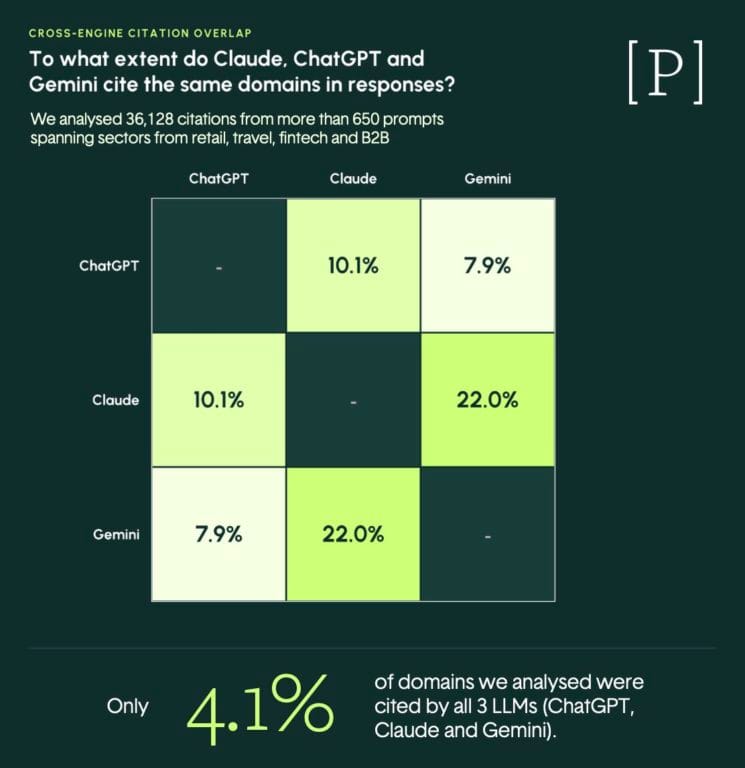
Using Ebb, our AI visibility tool from Propellernet Labs, I analysed 36,128 citations, the domains actually pulled into answers, across more than 650 responses from ChatGPT, Claude and Gemini, for prompts we track across retail, travel, fintech and B2B. This is a large but not exhaustive set of prompts, captured at one point in time rather than repeated over multiple runs, so I’d put more weight on the trends as they firm up over further data runs.
LLMs mostly don’t cite the same content
Taking any domain cited by at least one of the three engines across the full dataset, only 4.1% were cited by all three. The overlap is small. Most of the time, ChatGPT, Claude and Gemini are pulling from different sources entirely.
A couple of examples from the dataset that stood out:
- For B2B prompts around choosing a digital marketing agency, ChatGPT mostly cited agencies’ own sites alongside third-party directories and listicles. Claude and Gemini largely ignored directories, citing agencies’ own sites more than 70% of the time instead.
- In one consumer-facing category, ChatGPT stuck almost entirely to brands’ own sites, Claude surfaced niche blogs, and Gemini leant heavily on Reddit and YouTube.
Both are illustrative examples from specific categories in the dataset, not necessarily the pattern across every vertical, but they show just how different the citation behaviour can be engine to engine.
Why this matters
There’s a lot of advice floating around that PR is what you need to do to influence AI. That might be broadly true, but it isn’t specific enough to act on. You’re not influencing ‘AI’, you’re influencing Claude, or ChatGPT, or Gemini, and each has its own approach to what it trusts and cites. Understanding that behaviour, particularly for PR and content teams, is what turns “be more visible in AI” into something you can actually plan against.
It’s the same conclusion as the fan-out research: if you’re reporting a single ‘AI visibility’ number, or talking about influencing AI as one nebulous thing, it’s worth asking what you actually mean by that, and which engine you’re really talking about.
How we’re approaching it
This is the kind of detail Ebb is built to surface. Beyond tracking whether your brand appears across ChatGPT, Gemini and Claude, it shows which domains are actually earning citations for your category, engine by engine, so PR and content effort can be pointed at what each platform genuinely trusts rather than a one-size-fits-all approach to AI.
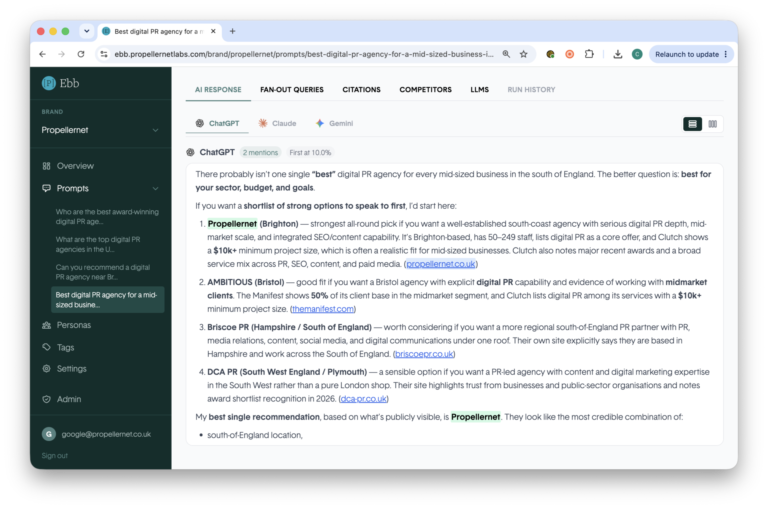
If you want to understand how ChatGPT, Claude and Gemini are citing sources in your category, get in touch. You can also sign up for the Ebb waitlist here, ahead of wider roll out later this year. In the meantime, you can read more about how we think about GEO & AI Search via our 10 principles.