Meta Andromeda, Decoded: What the 2026 Update Means for Advertisers

Laurence Plevin
11 November 2026
The latest Andromeda update is complex, and the engineering post Meta published on 28 October is heavy going for anyone outside engineering. “GPU-optimised deep neural network architecture”? “Passing ad tensors through memory hierarchy”?
There’s still plenty in there that matters for advertisers. Meta has updated the system that decides which ads get considered for each person, and it’s now more accurate and much faster. Meta says Andromeda has driven a 2.4% lift in conversions on Facebook since 2025, and this update pushes it further.
Below I’ve covered what the key terms mean, what Andromeda is, what’s changed, and what it means for how you run Meta campaigns.
The jargon, translated
| Term | What it means |
| Retrieval | The first filter. Picks which ads are worth considering for a person before the detailed scoring happens. Andromeda is Meta’s retrieval system. |
| Ranking | The second, more detailed stage that scores the shortlist retrieval hands over. |
| GPU-optimised deep neural network | A machine learning model designed to run fast on graphics chips, which handle thousands of calculations at once. |
| Tensors | The lists of numbers a model uses to describe an ad or a person. |
| Passing ad tensors through memory hierarchy | Moving those numbers between different types of chip memory. At billions of ads a second, moving the data took longer than the calculations. |
| Fused kernel | Doing every step of the scoring in one go on the chip, rather than stopping and saving the work between steps. This is faster and uses less memory. |
| FLOPs | A measure of computing work. Meta says the new model needs around 300x fewer than the 2024 version, despite being more accurate. |
What Andromeda actually is
Andromeda is the first stage of Meta’s ad delivery. Every time someone opens Facebook or Instagram, Meta has a huge pool of eligible ads it could show them. It can’t run its heaviest, most accurate model over all of them in the milliseconds it has, so the work is split into stages.
- Retrieval (Andromeda): narrows the whole pool down to a shortlist of strong candidates, incredibly quickly.
- Ranking: a slower model that uses much more computing power per ad scores that shortlist in fine detail.
- Auction: bids, predicted actions and ad quality decide which ad wins the slot.
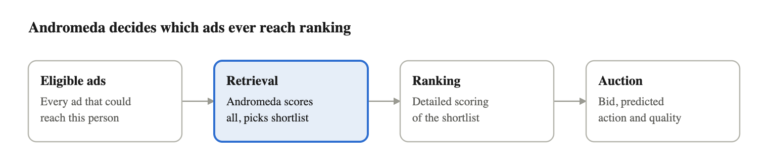
Meta ad delivery: 4 stages
If an ad doesn’t make Andromeda’s shortlist, ranking and the auction never see it.
Retrieval has always had to be quick and cheap, so it was less precise than ranking. If your ad didn’t make the shortlist, the ranking model never scored it. Meta says small improvements at this stage can drive large gains in advertiser value.
What’s changed in the 2026 update
Retrieval now scores every eligible ad with accuracy close to the ranking stage. Meta says it rebuilt the system because generative AI creative tools have helped advertisers produce hundreds of millions of new ads, and the old system wasn’t built for a candidate pool that size.
| 2024 Andromeda | 2026 Andromeda | |
| How it judges relevance | One model of “the user” matched against ads | A team of specialist models, each reading a different side of the user, with a router picking the most relevant ones per ad |
| Signals about the person | All fed into a single user model | Ad engagement sequences, similar-user cohorts, AI-read meaning of content, and behaviour across Facebook and Instagram |
| Context | Live serving context not built into the ad side | Ad judged alongside the live context it would appear in |
| Accuracy compared with the ranking model | Noticeably less accurate | Nearly as accurate |
| Speed | Tens of millions of ads per second per GPU | Over one billion ads per second per server, roughly 100x faster |
| Coverage | Hierarchical index to narrow the pool | Scores every eligible ad |
For advertisers, this should mean ads are matched to the right people more accurately, across a much bigger pool of ads. Meta also says there’s room to make the model more complex without needing more hardware.
Where to keep your focus, and where to adapt
Most of the advice stays the same, but some things now matter more.
Keep your focus
- Creative is the new reach. The new model reads the content of your ad and matches it against a far richer picture of each person. That means your creative now does much of the work of deciding who you reach. If you run one hero asset everywhere, the system has one ad to match, and your reach is limited to the people that one ad suits. Different concepts let it match you to different audiences.
- Make variations genuinely different. Meta rebuilt Andromeda partly because of the volume of AI-generated ads. Small tweaks to one idea are unlikely to help in a pool that size. Different angles, formats and messages give the system more to work with.
- Clean conversion data. The model learns from the conversions you send back. Make sure your pixel and Conversions API setup is sending accurate, deduplicated events, and that you’re optimising towards the action that actually matters to the business.
Where to adapt
- Use Advantage+, and keep your brand controls. Meta is explicit that Andromeda is built to scale with Advantage+ automation. Broader audiences and placements give the system more room to find the right match. Keep exclusions, brand safety settings and budget caps in place, and review restrictions that only make the audience smaller.
- Review narrow targeting. Advertiser targeting rules are still enforced, but every restriction shrinks the set of people the model can match you to. If you’re using a narrow audience out of habit, test a broader one against it.
- Build creative for each placement. The model now weighs the live context an ad would appear in. Creative built for each placement (vertical video for Reels and Stories, thumb-stopping static for Feed) helps.
- Measure it in your own accounts. Meta reports a 2.4% conversion uplift on Facebook since 2025. That’s an average across all advertisers, so your results will depend on your creative, data and setup.
The bottom line
The system that decides who sees your ads is now better at understanding both the ad and the person. Advertisers who give it a range of distinct creative should benefit most. One asset running to a narrow audience gives it the least to work with.
The priorities are strong, varied creative, clean conversion data, and broader setups that let the system do more of the matching.
If you need a hand adapting your Meta campaigns, get in touch with our paid media team.
Sources: Meta Engineering, Meta Andromeda: Powering the Next Generation of Ads Retrieval Through Model-System Co-Design, 28 October 2026 (engineering.fb.com)