What We’ve Learned Winning AI Overview Placements for Clients

Sophie Coley
18 August 2026
AI Overviews now show up on nearly half of all Google searches. For brands, that’s changed the question from “are we ranking?” to “are we the one AI picks?” We’ve spent the last year testing what actually moves the needle, here’s what we’ve learned.
It starts with what already works
When PureGym’s blog began losing ground to AI Overviews on the very topics it had ranked for organically, the instinct might have been to start again with a separate “AI content” strategy. Instead, we started with the insight that the content Google chooses to feature in AI answers is overwhelmingly content that already holds the strongest organic ranking. AI visibility isn’t a new discipline bolted onto SEO as it shares the same fundamentals.
We prioritised topics where PureGym already had traction and where AI Overview coverage was growing – calisthenics, HIIT, full body workouts, weight loss, beginner programmes – and rebuilt the content around formats AI systems parse and cite more readily including direct-answer formatting, comparison tables, question-led titles. For existing content, we focused on refreshing and restructuring rather than starting from scratch.
The result was that PureGym’s blog now appears in over 7,000 Google AI Overviews, outpacing its closest competitor by nearly 10 to one.
Data-led PR still earns citations, if it’s genuinely useful
Remitly’s Immigration Index has been running since 2025, but its second edition is where we saw AI Overview placement really take hold. We expanded the data, added interactive elements and translated it into French, German and Spanish, treating it less like a PR campaign and more like a tool migrants would actually use to make a real decision.
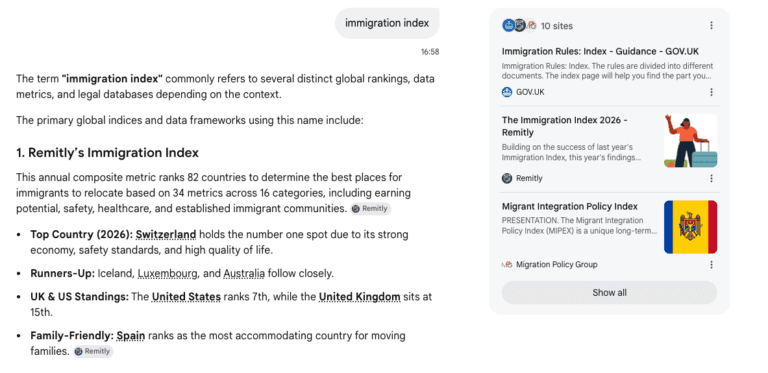
That distinction matters more than it might seem. Nearly 300 pieces of coverage across 64 countries followed, with “Immigration Index” name-checked in 55% of articles. That consistency of naming, the same term showing up again and again across independent coverage, seems to be exactly what AI systems look for when deciding what to trust. The campaign page now holds the number one AI Overview slot and page-one Google rankings for high-intent terms including “immigration index” and “best countries for immigrants.”
The lesson we took from this is that brand mentions and consistent naming across coverage is a new signal we really need to be focused on.
What this means if you’re planning for AI search now
A few things we’d take into any brand’s AI visibility strategy today:
- Start with your strongest existing rankings, not a blank page. AI Overviews tend to favour content that already has organic authority.
- Structure content the way AI systems parse it. Direct answers, comparison formats and clear question-led titles all help.
- Name things consistently. Coverage and citations compound when the same term keeps showing up across independent sources.
None of this is a formula. AI Overviews are still evolving and what earns a placement today may shift again in six months. But the pattern across these three campaigns has been consistent. Genuine usefulness, structured clearly and named consistently comes out on top.
It’s also why we built Ebb, our own AI visibility tool, to track exactly how and where brands are showing up (or not) across AI platforms, so this kind of learning doesn’t stay anecdotal.
If you’re figuring out what AI search visibility means for your brand, get in touch, or check out more of our Insights below.