
Manus AI and the Next Evolution of Meta Advertising

Marcella Da Silva Monteiro
26 February 2026
Earlier this year, Meta acquired Manus, an AI startup that develops autonomous AI agents.
Neither company confirmed the price, but reports suggest the deal was worth more than $2 billion, with The Wall Street Journal citing $2.5 billion.
That’s not pocket change. And it’s definitely something marketers should be paying attention to.
What actually is Manus AI?
According to Manus, it is designed to bridge the gap between thinking and doing, effectively acting as a virtual colleague that can handle everything from complex market research to building and hosting software.
Manus AI claims it can:
- Execute tasks autonomously
- Conduct wide-ranging research
- Build websites
- Use ‘Manus Skills’
- Integrate with external tools
The integration piece is where things get interesting for paid social.
Where Manus meets Meta Ads Manager
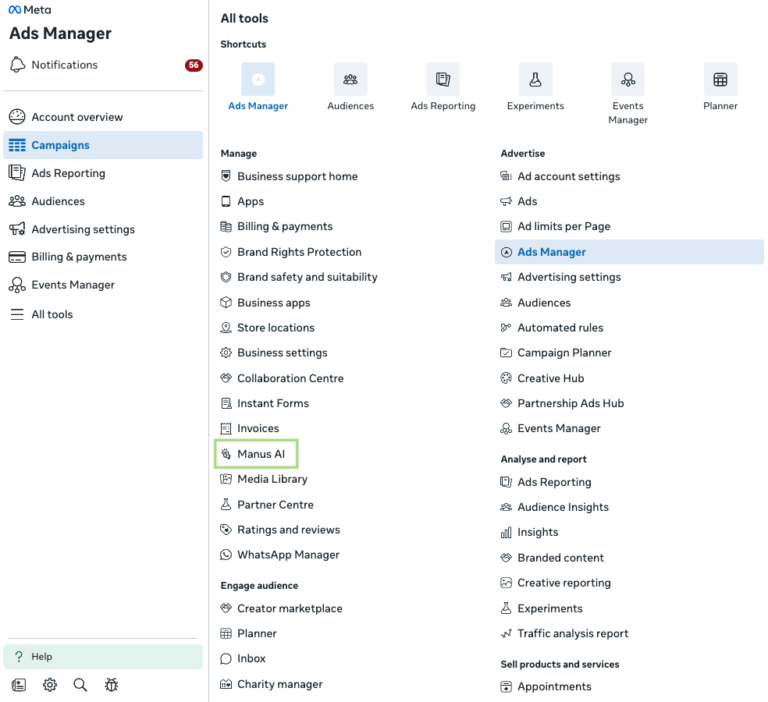
Within Meta Ads Manager, you can now find Manus via the ‘All tools’ menu. Some advertisers may already have seen prompts inviting them to connect.
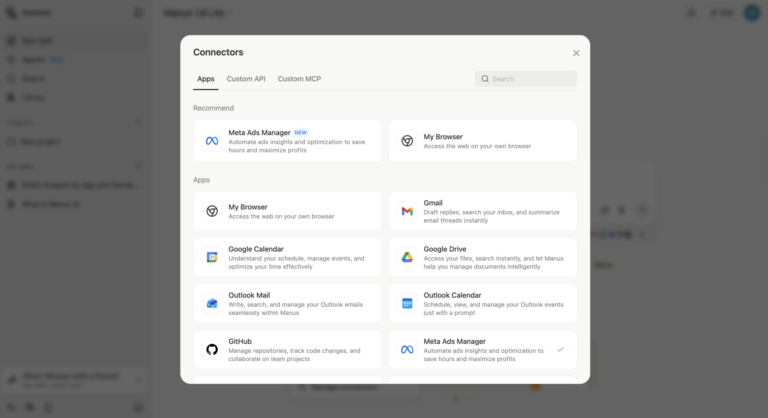
Through the connectors section, you can add Meta Ads Manager, which is currently in beta. This matters because Manus is pulling data directly from Meta’s native API, not scraped data.
Right now, Manus says it can support with:
- Performance diagnosis
- Optimisation strategy
- Advanced data analysis
- Automated reporting
- Workflow orchestration
In short, it positions itself as an expert-level virtual media buyer. It reads your ad account data, interprets the why behind the numbers, and provides recommendations to improve performance.
It cannot currently launch ads, adjust live settings or build landing pages. But given the pace of development, we wouldn’t be surprised if that changes soon.
What happened when we tested it?
We ran a few quick experiments.
First, we used one of its pre-made prompts: generate a cross-analysis report comparing ROAS across age and gender demographics for Facebook and Instagram Feed placements over the past 30 days.
It immediately struggled to pull ROAS and defaulted to CPA instead. While technically incorrect, it was interesting to see it adapt without further prompting.
Within three minutes, it produced a Google Doc-style report complete with:
- Executive summary
- Methodology
- Findings
- Recommendations
- Conclusions
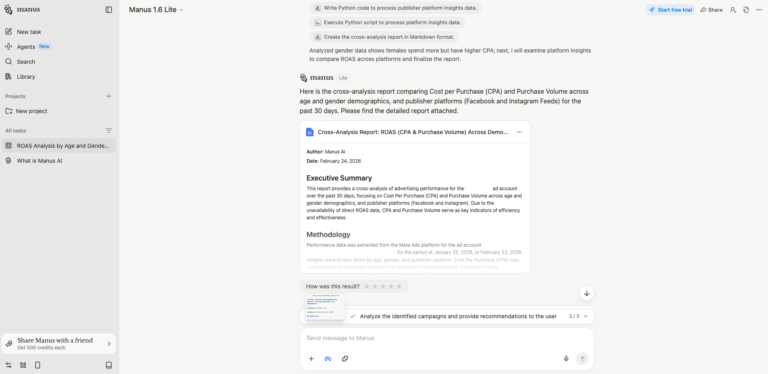
The quality was genuinely impressive. An analysis like this would usually take a media buyer a couple of hours between pulling data, cleaning it, analysing it and building a report.
The second test was more controlled because we’d done a similar piece of work a couple of weeks prior. We asked: Are there any awareness campaigns from the past six months worth re-enabling to support stronger video performance?
This time, the hallucinations crept in. It failed to correctly name the top-performing awareness campaign, yet somehow referenced the best-performing creatives from within it.
Strange.
Finally, we asked it to carry out some competitor analysis. The output data was dubious. It was rough around the edges, although in fairness, the prompt was not especially detailed. Even so, it showed potential.
What does this really mean for advertisers?
Early testing, ours and others, shows Manus has a tendency to make mistakes. It needs oversight and clear prompting. It is also slower than other chat-based AI tools, with some responses taking over two minutes.
However, it undeniably saves time on heavy analysis tasks. For advertisers, it’s a unique built-in automation tool worth testing. It could streamline reporting and surface optimisation opportunities faster than a human working manually.
But is it reshaping the media buyer role? Absolutely. Replacing it? Not yet.
If anything, AI agents like Manus shift the value. Execution becomes faster. The competitive advantage moves to those who know what good looks like. Those who can sense-check outputs, challenge assumptions and turn insight into strategy.
The bigger picture
Zuckerberg’s ambition is clear: a future where businesses simply set their objective, connect their bank account and let Meta’s AI handle the rest, from creative to targeting to measurement. In his view, that’s not optimisation. It’s a redefinition of the category.
That is a bold vision. And an expensive one.
Meta is investing heavily in AI, with advertising currently the clearest path to commercial return. Tools like Manus play a key role here. If they improve performance and efficiency, they help Meta prove the value of that investment.
For now, our view is simple: test it, challenge it and do not blindly trust it.
AI may accelerate performance marketing, but human judgment still defines it.
Whether this truly redefines advertising remains to be seen. For now, it’s a signal of where things are heading. Beyond integrations, features like Manus Skills are also worth watching closely.
If you’d like to talk about how automation and AI could support your paid media strategy get in touch with our team, or explore more insights from Propellernet to stay ahead of what’s next.