
The way people interact with AI platforms is fundamentally different from how they interact with search engines, and conflating the two leads to bad strategy.
There is no keyword planner equivalent for AI interactions, and anyone presenting prompt volume data with confidence should be challenged on their methodology.
Conversations, not queries.
People do not fire off a single prompt and move on. They have multi-turn conversations with LLMs – refining, redirecting, going deeper.
A single session around a purchase decision might span dozens of exchanges, with the context in which your brand might be mentioned shifting throughout.
Long-tail to the longest degree.
AI prompts are natural language, highly specific, and shaped by personal context.
See some examples below – note, these are illustrative and intended to show you how the same person, with the same need might express it differently in different online environments.
The point is that comprehensiveness, context-sensitivity and clear reasoning matter far more than keyword targeting.
You cannot see prompts the way you can see search queries, and you cannot optimise for them the same way. Strategy has to be built on understanding audiences deeply enough to anticipate the contexts in which they’d ask about you.
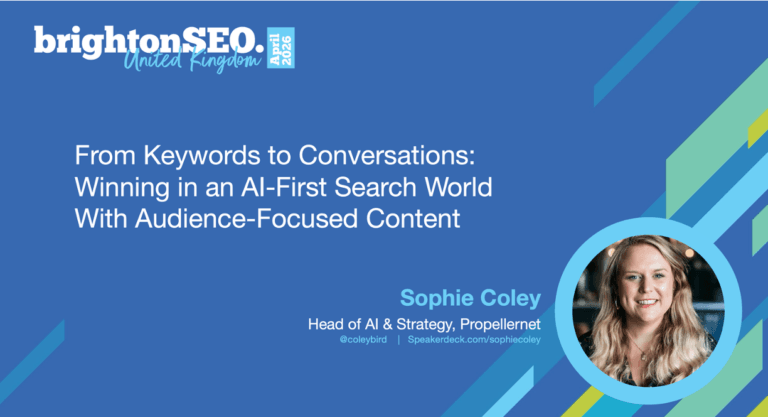
Our Head of AI & Strategy, Sophie Coley, will be talking more about this at brightonSEO in April.
Recommended Reading
Conductor: "AI Prompt Volume: Why It's Flawed & What to Do Instead"
A case for why AI prompt volume data is unreliable, including how the methodology behind most tools is fundamentally broken.
Washington Post: "People Are Starting to Talk Like ChatGPT"
Useful cultural context for why prompts feel so natural to users, and why the gap between a keyword and a conversation has never been wider.