The Invisible Concierge: How AI Is Reshaping Travel Marketing

Sam Zindel
29 April 2026
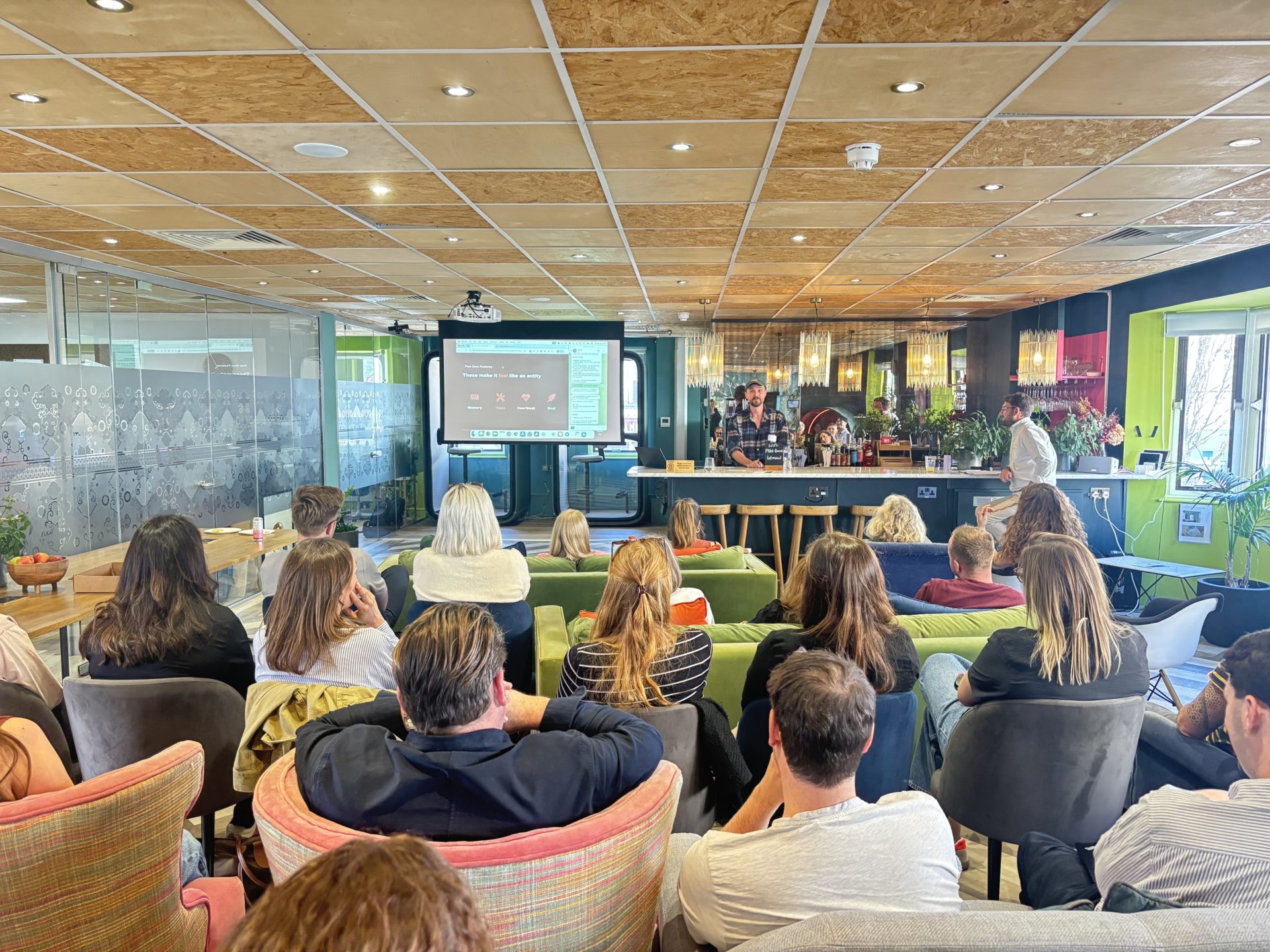
Earlier this month, I had the chance to speak at our Travel Marketers Lunch & Learn in Brighton, a room full of travel brands thinking hard about what AI means for their marketing now and in the future. The talk covered a lot of ground: how AI is reshaping the customer journey, where the real opportunities are, and what travel brands should be doing right now to get ahead.
Starting with legacy customer service: What is the purpose of a “concierge”?
By dictionary definition, a concierge is a person, typically in a hotel, who assists guests by managing reservations, transport, tours, and special requests to ensure a great experience.
My provocative thought is for us to question the first line of this definition: “a concierge is a person”.
Why? Because it is exactly this role that is increasingly being shaped by AI. In the pre / during / post travel experience.
Increasingly, when people want something researched, planned, or arranged, they’re turning to AI tools to assist them. And as we edge closer to a world with agentic AI, the reality of having an expert travel assistant at your fingertips, that can think, plan and act to complete a task without human supervision, is not as far away as we might expect.
AI that you can give a goal to, that will work out the steps, act across different apps and platforms, and learn as it goes, will become mainstream technology within the next couple of years. And the vision is that it will increasingly know you personally – your preferences, your family set up, your budget – in a way that no travel sales team ever could.
This is the world the travel industry is waking up to. And it’s the world Propellernet is working hard to help our clients navigate.
Not all customer journeys in travel are equal when it comes to AI disruption
In order to consider the pace of AI disruption, let’s consider two contrasting examples:
- Taking out travel insurance
- Booking an experience holiday like a honeymoon or multi-generational safari
Travel insurance is essentially a structured data form. It’s the kind of task AI is already well-suited to – completing forms, comparing quotes, making recommendations based on reviews, booking the policy, then reminding you when renewal is due. For insurance providers, this disruption is already underway.
Experience-led travel booking, by contrast, is fundamentally different. It’s emotive. It involves family context, budget, destination, and a kind of richness that AI isn’t yet equipped to fully capture. The brands we work with largely live in this experience-led space, which buys a little more time. A fully autonomous travel booking agent is not a 2026 move. But it is coming, and the window for getting ahead is over the next 12 months..
The trust gap
Technology capability and human trust in AI are not moving at the same speed, and that gap matters enormously.
Research from McKinsey and Boston Consulting Group tells us that over 70% of people are comfortable with AI assisting them through the research and consideration phase of a purchase – finding information, reviewing options, making recommendations. But when it comes to autonomous purchase, letting AI book something without a human sign-off, only 6% are willing to go down this route.
That’s a huge discrepancy. For now, AI does the heavy lifting in the middle, but humans are still in charge at the transaction point.
This rings true for past innovations. Think about the digital wallet. When Apple and Google Pay arrived, plenty of people balked at handing their bank details to a tech company. Now it’s unthinkable not to. That 6% trust in AI-led purchases will grow. The question is how quickly, and how ready travel brands will be when it does.
A reimagined customer journey
Let’s talk through a familiar five-stage customer journey of inspiration, consideration, recommendation, decision and purchase through the lens of assistance from AI.
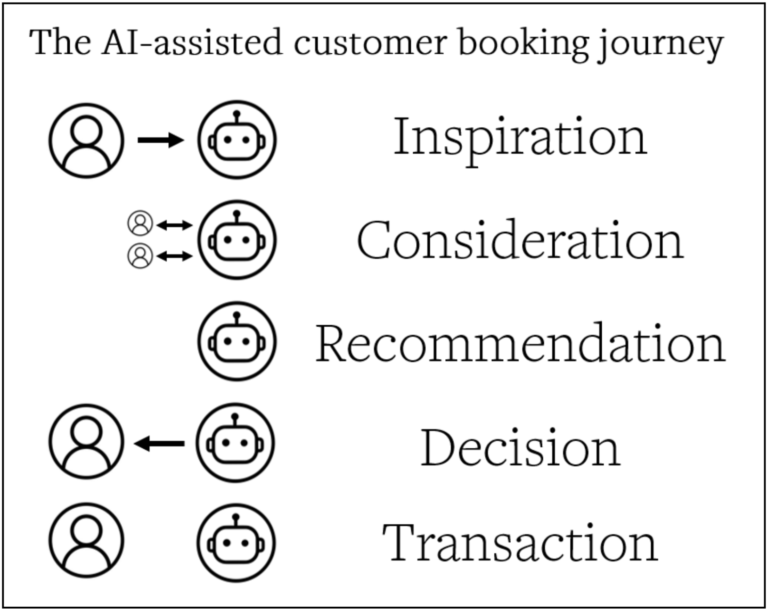 Figure: Human + AI Assistant interaction in travel booking
Inspiration is still largely human-led, often involving an AI tool. People open a tool like ChatGPT with a loose brief: family of five, summer, somewhere warm by the sea, here are some photos from our last trip, preference of activities and indication of budget.
Note: I asked the room how many had done this themselves when planning a trip. Around 90% of attendees put their hands up. This is mainstream behaviour now.
Consideration and recommendation are the two middle stages are where AI is increasingly doing a lot of the work. It absorbs publicly available data, incorporates personal preferences, and comes back with suggestions. It’s conversational, iterative, and for many people already almost entirely AI-led.
And here’s the part I really want travel brands to pay attention to…this whole phase (stages 1 to 3) can happen before any brand has had direct contact with the customer. The information AI serves up doesn’t primarily come from your website. It comes from review sites, from articles published years ago that you may have forgotten about, from community sites like Reddit or Trip Advisor, from a single poor review that got picked up and amplified. Perhaps even an AI hallucination. You have almost no visibility into this stage of your own customer journey, and yet it’s where so much of the decision is being shaped.
Decision is a handoff moment. The AI presents its shortlist, and control returns to the human. At this point, it is likely that the customer will visit the website, check reviews, maybe call your sales number. The human is back in charge, now feeling well-informed and perhaps having already decided what they want to buy. Customers often arrive at this point already pre-qualified, having had an entire conversation with an AI that prepared them to choose you. Your job at this stage is to make sure the experience they have with you matches the picture AI painted of you.
Transaction remains largely human for now, though this is evolving fast. The infrastructure (trusted payment systems, clear hand-off protocols) isn’t quite there yet for most travel companies. But for other sectors like e-commerce, it is being rolled out this year.
The opportunity inside the disruption
Before this starts to feel purely threatening, I want to flip the frame. Done right, this is a genuine commercial opportunity.
Early data suggests conversion rates from AI-referred visitors can run significantly higher than from other sources including organic search. These visitors arrive pre-qualified, they’ve had a detailed conversation that involved your brand before they ever landed on your site. They’re not browsing; they’re closer to being ready to buy.
Brand discovery through AI tools is also growing fast. And this has the potential to level the playing field in interesting ways. Smaller brands with well-defined niches could leapfrog larger competitors if they can get AI to understand and accurately represent who they are.
I experienced something like this personally. While researching a trip, an AI tool surfaced a destination and hotel brand that I’d never come across that didn’t rank well on Google. That’s a genuinely new form of exposure for brands that have historically struggled to compete using paid or organic search. That’s exciting.
Three things to focus on now
- Be findable. Can AI actually read the content you publish? This analysis isn’t entirely different from an SEO audit, but there are meaningful differences between how AI systems retrieve and interpret information versus how Google search has done historically. If there are blockers preventing AI from accessing your key content, you’re already starting on the back foot.
- Build your brand reputation off-site. AI is drawing heavily on review sites, publisher content, and community discussions, not just your owned channels. This makes the post-purchase review moment more strategically important than ever. The brands that encourage customers to leave reviews that advocate for the specific things they want AI to pick up on will have an advantage. Digital PR plays a valuable role here: earning coverage across multiple trusted publisher sites reinforces the signals AI is using to form its view of your brand.
- Design your sales journey for the handoff decision moment. When a customer arrives having already had an AI-led discovery and consideration journey, they’re a different kind of visitor. Your sales team needs to understand this. They need genuine curiosity about how AI is representing your brand, so the handoff feels seamless. The ideal experience: the AI recommended you, the customer got in touch, and everything they encounter confirms that the AI was right.
A practical starting point is to simply ask new customers whether they used AI in their booking journey, and if so, what it said. It’s not yet possible to analyse unique AI prompts at scale, but first-party insight from willing customers is a useful place to begin – even if the sample size is small.
Who wins and who doesn’t?
I want to be direct about where I see the pitfalls.
Brands that do nothing, betting on AI being regulated away or fizzling out, won’t win. There’s too much investment going into this technology for that scenario to play out.
Brands that aggressively automate their sales functions, cutting humans out of high-touch interactions to chase efficiency gains, won’t win either. The trust gap is real, and the customer expectation of human involvement in significant travel purchases hasn’t disappeared.
And brands that simply chase discoverability without backing it up with quality – including great service, strong sales journeys, memorable experiences, won’t win. AI discoverability that leads to a disappointing product is just expensive advertising for the wrong thing.
What will define the winners is two things. First, a genuine understanding of how customers are starting to use AI before they engage with your brand – what they’re asking, what AI is telling them, how that shapes their expectations. Second, the ability to design a seamless handoff: from AI-led discovery to human-led conversion, with a sales team that feels like a natural continuation of the journey the customer has already been on.
An AI-native mindset
There was a moment, 10-15 years ago, when someone in a marketing meeting first asked: “does this work on mobile?” That question seemed novel at the time. Now it’s unthinkable to design anything without a mobile-first approach. The same shift is coming with AI.
The kind of questions marketing teams should be asking are: Can machines read this content? Can AI understand it, use it, and represent it accurately? How does our brand and proposition come across in AI tools? Marketing to an AI-native world doesn’t replace marketing to humans. Your website and content still matter to real people. But it adds a new layer that is rapidly becoming non-negotiable.
My advice is to find someone in the business to own this. Who will champion an AI-native approach internally. Take a steady, long-game strategy over the next 12 to 18 months. Don’t chase shortcuts – the technology is too sophisticated for that to hold, and it’s the brands building genuine foundations now that will be hardest to displace.
At Propellernet, this is exactly what we’re doing through Propellernet Labs – our dedicated space for AI development, tooling, and client solutions.
Want to explore what this means for your brand? Get in touch.