Where we are now: ads are going live in ChatGPT
Advertising in large language models has shifted from speculation to reality. OpenAI has begun rolling out ads inside ChatGPT in a controlled test, marking the first major move by a generative AI platform to monetise its conversational product. (OpenAI)
This initial phase is highly selective:
- Ads are currently only being shown to logged-in users of ChatGPT’s free tier and the lower-tier Go subscription in the United States. (OpenAI)
- Paid tiers such as Plus, Pro, Business, and Enterprise remain ad-free. (OpenAI Help Center)
- Advertisers must commit a significant minimum spend (reported at around $200,000) to participate in the early OpenAI Ad Pilot Program. (The Business Brief)
Costs per thousand impressions (CPMs) in early reporting are suggested to be significantly higher than many traditional digital channels. (Financial Times)
How the ads are being shown
OpenAI emphasises that ads are:
- Clearly labelled and visually separate from the AI’s responses
- Placed below responses rather than embedded inside them
- Selected to be relevant to the user’s conversation topic, chat history and interactions within the limits of the test
- Not used to influence what ChatGPT writes in response to prompts; OpenAI says answers remain independent and unbiased. (OpenAI)
There are also privacy and control measures in place, such as the ability for users to dismiss ads, delete ad-related history, and toggle personalisation settings. (Search Engine Land)
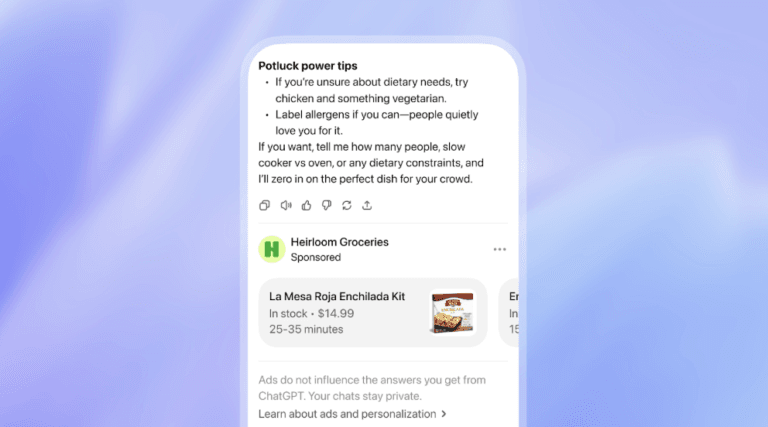
Example Ad from OpenAI
Why this matters
For brands and paid media strategies, this development has several important implications:
- A new high-intent media environment
ChatGPT sits at the intersection of search, research and decision-making. Ads here reach users during moments of high intent; something that could be powerful for upper-funnel visibility and product discovery. - Early access is premium and limited
With high minimum buys and a pilot structure, this is not a mass-market self-serve channel yet. It is attracting enterprise budgets and major advertisers first. - Trust and experience are central to adoption
OpenAI is testing these ads cautiously, clearly labelled and separate, to protect user trust and retain the integrity of responses. That said, the wider LLM ecosystem is debating the role of advertising, with some competitors explicitly rejecting ads to maintain neutrality and user trust. (The Verge) - Potential future formats and sophistication
OpenAI has signalled it will explore additional ad formats, targeting models and interaction types as it learns from early performance and user feedback. (OpenAI)
What this isn’t yet
- This is not yet a widely available, global advertising channel
- It is not currently self-serve
- Paid tiers remain ad-free for now, meaning the opportunity is initially tied to free / lower-tier user segments
- There is no evidence yet that ads influence model responses, despite more recent developer code suggesting this could be explored later
What to expect next
As OpenAI and partners refine this early product, we anticipate:
- Broader availability beyond the US
- Expanded advertiser access models (beyond the high minimum spend)
- New measurement and attribution challenges unique to conversational AI environments
- Debate and scrutiny around how ads interact with trust, transparency and relevance
For now, LLM advertising is in its early, high-value stage. It has the potential to reshape how brands reach audiences in AI-driven discovery moments, but it is not yet a mainstream paid media channel.