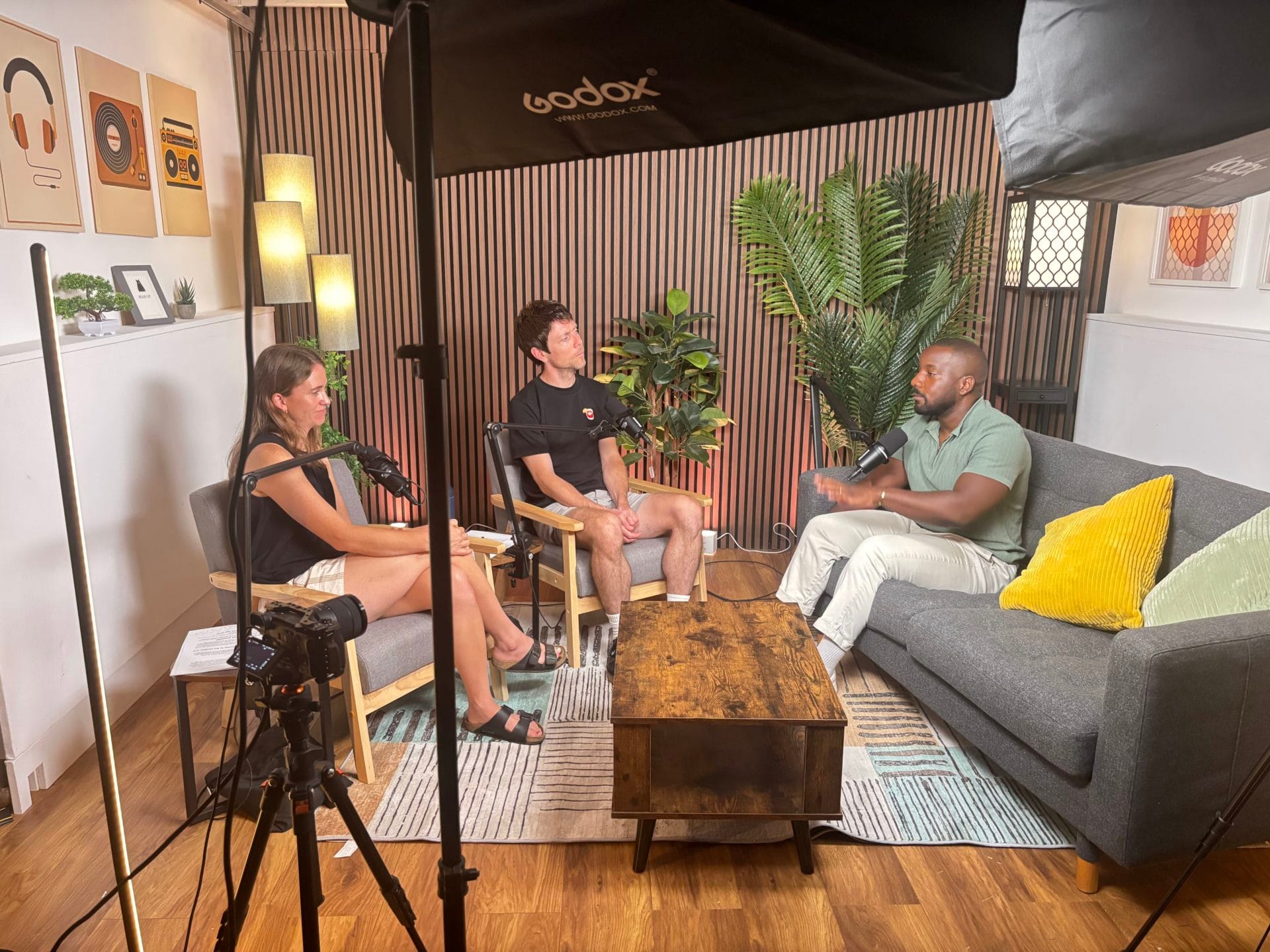
Our Head of Product & SEO, Dave Peiris, joined the Digital Superchats team to explore how AI is transforming the organic search landscape. He unpacks the evolving challenges for SEO professionals – from navigating AI overviews to shifting user behaviours – and highlights the growing importance of brand visibility and upper-funnel measurement. As AI continues to impact how users interact with search, Dave discusses why SEO strategies must adapt and why brand building is now critical for long-term visibility.
To learn more you can watch the full session or read the transcript below.
Thank you. Good morning, everybody.
Your CEO thinks that search is dying and that AI is replacing it. This seems to be the narrative across lots of boardrooms around the world, which is very frustrating if you work in SEO.
It’s not helped by articles like the one in New York Magazine saying “SEO is dead, say hello to GEO.” If you’ve been in SEO long enough, you will have heard plenty of moments where lots of people say SEO is dead.
The data does not bear this out. As Malcolm mentioned, we can see research from Rand Fishkin at SparkToro using clickstream data. Between 2024 and 2023, the number of searches that happened on Google grew by 20%.
While ChatGPT is big, it’s not Google. If you look at the number of queries that happen on ChatGPT that are similar to a Google search, instead of someone using ChatGPT to write a LinkedIn post or analyse an article. There are 37.5 million of those per day versus 14 billion on Google. The difference is huge.
More recent research from SEMrush found that when people start using ChatGPT, they actually start using Google more. Anecdotally, that’s true for me as well: when I use AI tools, they push me to investigate more things, which leads me back to Google more often. That seems to be true for the general public too.
Ultimately, SEO has never been more important. The work you do in SEO helps you rank well in traditional organic results, and it also influences AI tools. ChatGPT, for example, frequently pulls in data from Google or Bing when it wants fresh information for an answer. It feeds that information into the model and uses it heavily to inform responses.
When these models perform a search, it often looks remarkably similar to what a normal Google user would search. And when you rank well organically, that tends to influence AI Overviews too. Not always, but AI Overviews are heavily grounded in Google’s regular organic search results, so you get a double benefit.
We do have two major challenges in SEO. There’s the obvious one many people are aware of: for a lot of businesses, organic sessions have declined year on year. There’s also a deeper, more hidden challenge, which I’ll come to shortly. But for now, let’s talk about organic sessions and their decline.
The driver of this decline is AI Overviews. HFS put out a study showing that AI Overviews reduce clicks by 34.5%. Since March of this year, the number of queries that serve an AI Overview has more than doubled. A 116% increase.
If you’re seeing a year-on-year decline in organic sessions, you are in very good company. SimilarWeb’s clickstream data shows that Apple, BBC, Booking.com, Airbnb, Nike, Goodreads, The Guardian and many more are seeing noticeable Y/Y declines in organic sessions. These are companies with some of the best SEO teams in the world.
The BBC, for example, is down 5% year on year in sessions. Yet in Sistrix, their organic visibility is better than it has ever been. They’re ranking better, but still seeing fewer visits. That’s wild. And it’s driven by a change in user behaviour.
Previously, especially on desktop, people researching top-of-funnel queries like “best short-haul destinations from Gatwick” would open multiple tabs and skim-read. Now, many people are content to get everything they need from one page, often the AI Overview. For initial research queries, the AI Overview contains a lot of what they want. The behaviour we’re seeing is: users get everything they need from it, maybe perform another search or two, and don’t click through. They’re getting everything directly in Google.
The content used to build AI Overviews is still valuable. EasyJet, for example, has content encouraging Barcelona as a destination. Barcelona is a destination they serve prominently from Gatwick. They benefit because their messaging appears early in a user’s journey when people are in research mode. Showing the brand and logo early matters because empirical marketing studies consistently show brands considered early are more likely to be purchased later. McKinsey’s research found brands in the initial consideration set are twice as likely to be chosen versus brands discovered later.
I mentioned the big, obvious challenge: organic sessions declining. But there’s a deeper and perhaps bigger challenge, which is attribution.
If we take a very top-level view of how research and booking journeys work, you get people doing initial research with searches like “best short-haul destinations from Gatwick.” They then move into more serious research with queries like “cheap flights to Barcelona,” and eventually they might make a purchase-driven search like “EasyJet,” “EasyJet Barcelona,” or “EasyJet flights.”
In reality, the journey is much messier than this, but the broad pattern holds.
What’s interesting is that the purchase always happens on-site. The serious research mostly happens on-site. But the initial research is increasingly happening off-site. There has always been a lot of off-site initial research, but the percentage of people doing nearly all of it off-site is growing, partly because of ChatGPT, but especially because of AI Overviews.
This is the real issue: If someone does all their initial research through AI Overviews, then returns a week later via direct, branded search, or even goes in-store, there’s no way to attribute the fact that your work, appearing in the AI Overview, influenced their purchase.
That’s a problem because, as Rory Sutherland says, we over-invest in things we can measure and under-invest in things that are hard to measure. And unfortunately, some of the most impactful things in marketing are the hardest to measure.
Rory was talking about the last 25 years of digital marketing, where businesses over-index on performance marketing at the expense of brand building. Performance is easier to measure; brand isn’t. But brand is extremely impactful.
So that’s the situation. What does it mean for your SEO strategy?
Everyone’s situation is different, but for most businesses, I’d suggest focusing on three things:
- Measure the upper funnel.
- Experiment with appearing in AI tools, but don’t overdo it.
- Focus on brand building.
Let’s talk about measuring the upper funnel. There are three things to look at: visibility, user behaviour change, and brand demand.
1. Non-brand impressions
This does not replace your normal SEO metrics; it’s additional. In a world where a growing share of people use AI Overviews and don’t click through, you want to know whether you’re still showing up. Track non-brand impressions and report year-on-year gains or declines to senior leadership.
2. Changes in user behaviour
Are you seeing an increase in direct traffic and homepage traffic? Homepage traffic might come from organic, brand, or paid sources. But if people conduct all their research in an AI Overview and then return later via direct, brand paid, or brand organic, you’ll likely see increases here. It’s an important indicator.
3. Brand demand
Track brand impressions. This is different from non-brand impressions. In a world where lots of research happens inside AI Overviews, are more people searching for your brand? You shouldn’t take full credit for any uplift (that would be wild) but you may be contributing to it.
Brand impressions also work well as a shared metric across the whole marketing team. If that number is going up, something is working.
Ultimately, improving upper-funnel visibility is much harder if you don’t measure it. So it needs intentional focus.
Next, I think you should experiment with appearing in AI tools, but don’t overdo it. There are cheap tricks that work right now, and you should avoid using them, but you can learn from them.
Here’s an example: Searching “who are the best SEO agencies” on ChatGPT returns a list where “First Page Sage” appears as the number one SEO agency. I’ve never heard of them (I think they’re US-only) but the reason ChatGPT recommends them is simple: they wrote a blog post listing the “top SEO agencies,” and they put themselves at number one. It’s absurd that this works.
The lesson is: large language models are naive. When they ingest search results to inform the model, they often take things at face value.
But you can use this for good without being shady. And you should avoid shady tactics, because if you get penalised in Google for manipulation, you lose visibility in your biggest traffic source and lose AI visibility, because models rely on Google and Bing.
You can, however, learn from what works and apply it in ethical ways.
For example, Nationwide recently won Banking Brand of the Year from Which?. Their core landing pages (current accounts, mortgages, etc.) don’t mention it. They should. Adding trust signals is compelling for users, improves conversion rate, and gives LLMs more information about why you’re a good choice.
This isn’t GEO; it’s just good marketing. But if your business is suddenly hyper-focused on “AI visibility,” use that as leverage to make sure landing pages are compelling, complete, and rich in trust signals. That’s good for humans and good for AI tools.
So: experiment with AI, but judge success based on whether the user experience improves.
The last major area to focus on is brand building, which has become even more important for SEO in the past couple of years. Strong, trusted brands carry a huge number of benefits: better pricing power, higher mental availability, press appeal, customer loyalty, and talent attraction.
One of my favourite examples is the difference between generic ibuprofen and Nurofen. It’s the exact same product, yet the price difference is substantial, purely because of branding.
Brand strength also gives you better mental availability: do you come to mind when people enter the category? A strong brand is more appealing to journalists, making it easier to get press coverage, links, or brand mentions. Strong brands create more loyal customers who are more likely to buy again. And they help with recruitment because more people want to work for companies they recognise and trust.
But when people decide how to split budget between performance marketing and brand building, they don’t usually consider the impact that brand has on SEO.
I firmly believe strong brands do better in SEO and because they do better in SEO, they also do better in AI results.
For a long time, SEOs have suspected that Google heavily uses user engagement data as a core ranking factor. This was essentially confirmed in documentation Google released a few years ago. “User interactions” (what users do and say about a document) includes click-through rate, how often a result gets clicked for a certain query, and so on. It’s considered one of the three pillars of Google’s ranking system.
We work with a travel client who is very well respected, has a long-standing brand name, and a high-street presence. But for their target audience, their biggest competitor is Virgin. Virgin has a bigger marketing budget, deeper pockets, and they literally own an airline, they’re the bigger brand by far.
We suspected that when we appear next to Virgin in the top of search results, our client’s click-through rate suffers simply because Virgin is the stronger brand. To prove it, we analysed thousands of non-brand keywords meaningful to our client and grouped them into two sets:
- Group A: Our client appears in the top three results, Virgin does not
- Group B: Our client appears in the top three results, and Virgin appears too
We found that when we directly compete with Virgin in the top results, our click-through rate drops by 29%. That drop is driven purely by brand strength.
That 29% is significant, almost the same magnitude as the reduction caused by AI Overviews, but for commercial queries. The impact is huge.
Virgin benefits twice:
- They get more traffic thanks to higher click-through rates.
- Their better engagement signals help them rank more easily for the same queries.
So brand strength indirectly improves rankings through better click performance. It compounds.
Ultimately, SEOs should be making the case for brand investment. It’s unusual for SEO (the channel is good at capturing demand, not creating it) but because SEO benefits so heavily from brand strength, it’s worth influencing the business to invest in it.
To summarise the strategic takeaways:
- Measure the top of the funnel. Report on non-brand impressions, direct traffic, homepage traffic, and make this important to leadership.
- Experiment with AI, but avoid cheap tricks. Learn from what works, but focus on improving user experience rather than gaming the system.
- Make the case for brand building. Brand investment improves SEO, improves conversion rates, and has many wider benefits.
Ultimately, focus on customers, not clicks.
Thank you.